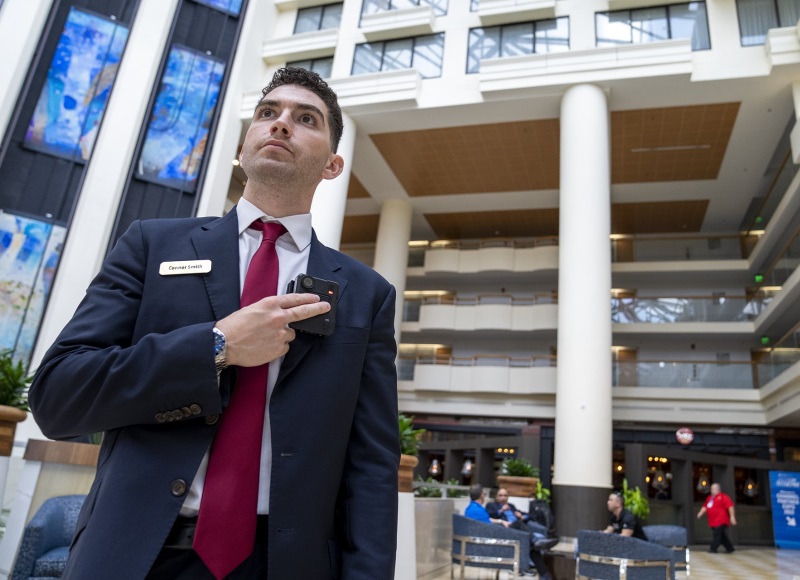
A body-worn camera is a compact wearable device that captures and transmits both sound and video information. This means that when the footage it captures is viewed, whether in real time or after the situation, there is strong evidence showing what occurred. In some environments, body-worn cameras can be integrated with CCTV and two way radios to trigger an emergency recording.
The purpose of body-worn cameras varies slightly from sector to sector, so we’ll examine some examples to demonstrate its uses. We’ll look at how body-worn cameras can help people, and in particular lone workers, in industries ranging from security to firefighters and healthcare.
Emergency services and private security workers
When body-worn cameras aren’t used, interactions between emergency services or security workers and the public often devolve into arguments about what actually occurred. For example, a member of the public who has attacked a firefighter may say that they were mishandled or incited in some way. Or, there can be differing perspectives of what happened at the scene of an accident. In firefighting and security work, the purpose of body-worn cameras is to:
- Encourage truthfulness from those present. For example, an angry member of the public may lay a fictitious or exaggerated complaint against a security worker, but is less likely to do so when they know that there is recorded evidence of the interaction.
- Provide stronger evidence in court proceedings. If an incident leads to a court case, the court can see and hear what occurred instead of relying on conflicting testimonies from witnesses.
- Help to settle investigations. Sometimes, significant events can unfold without witnesses being aware of just how important they are. If something that occurred at a particular time must be investigated, body camera footage can help investigators to reach a conclusion.
- Emergency services and security workers. Although a body camera is not a weapon, people will be aware that their actions are being recorded and transmitted. This reduces the potential for violent actions being directed at a firefighter or security personnel. And, should support be needed, real-time video and alarms can result in faster, better-coordinated responses.
- Monitor and improve the implementation of security procedures. Security workers wearing body cameras will work harder to act in accordance with established procedures. Video footage also helps their supervisors to look for areas for improvement and identify training needs.
- Increased accountability. Thanks to the visual and audio recorded, general accountability is certainly greater when body camera footage can be used to review interactions.
Lone workers in various industries
Even in hazardous industries like construction and energy and renewables, it’s sometimes necessary for workers to perform tasks unaccompanied. Without support, lone workers may be at risk. In the context of lone work, a body camera can:
- Act as a lifeline. If things were to go wrong, for example, a worker is injured and is unable to call for help, a body camera can be a life-saving device.
- Ensure compliance with procedures and keep others safe. Work carried out by lone workers can impact the safety of many people on or near the site and must often be performed in accordance with strict procedures. Lone workers wearing body cameras are more likely to adhere to safe work methods.
- Deter abuse or assault. When lone workers must work with the public, they can be at risk. Body cameras can easily be seen and people are less likely to behave poorly when they know that their actions will be linked to video evidence. Besides this, the worker is able to raise the alarm if they feel that they are in danger. In essence, your lone worker is no longer “alone.”
Body-worn cameras in healthcare
Disturbing news stories and worrying research results indicate that health workers are in danger. The British Medical Journal found that 37 percent of healthcare workers had experienced verbal abuse in the month leading up to its survey. One in five GPs had been threatened, 51 percent of workers had witnessed acts of violence perpetrated against staff, and 67 percent said that they felt the situation was becoming worse with the passage of time.
On the other side of the coin, there are reports of abuses toward vulnerable patients perpetrated by health workers – and some of these have been extreme. An article published by the Royal College for Nursing calls for the use of body-worn cameras to protect healthcare workers and patients alike. Specifically, it’s believed that body-worn cameras can:
- Help to defuse aggressive or potentially violent situations. The premise here is that the aggressor knows they are being recorded and that there will be evidence against them.
- Help healthcare workers to act with greater confidence since they are aware that blame can’t be apportioned to them and are able to summon help more quickly.
- Allow health workers to raise the alarm if situations are escalating beyond their control.
- Improve staff satisfaction and feelings of security since they are able to feel supported.
- Footage can be used as training examples for better preparedness in potentially violent situations.
- Help to ensure that correct procedures are followed in the workplace, thereby protecting patients.
Body-worn cameras: A safer workplace and better workplace practices
To sum up, body-worn cameras aren’t a panacea, but they can help to promote safer workplaces and better implementation of procedures. Thus, they provide added protection for both workers and members of the public. At Radiocoms, we offer a portfolio of body-worn cameras to suit a range of working environments. Contact us to find out more about our communications systems and solutions.
Read more
The UK’s lone working legislation explained
4th April 2024
What is the purpose of body-worn cameras?
22nd March 2024
Our guide to lone worker safety
4th March 2024
Prioritising health and safety: the need for a proactive approach in today’s workplace
28th February 2024
Our brief guide to construction site safety
16th February 2024
How to support difficult evacuations with Rob Horton, Staffordshire Fire & Rescue Service
4th January 2024

Best practices and considerations for implementing a dispatcher system
10th December 2023
Are your voice communications and data safe from cyber attacks?
17th November 2023
Let’s start a conversation
If you would like further information, or to discuss your requirements onsite:
Book An Appointment | Arrange A Quotation | Call 033 3939 0022